Questões de EFAF Ciências - Terra
94 Questões
Questão
15 10781808
Fácil
OBQJr 8° ou 9° Ano - Fase 1 2015
Os gráficos abaixo trazem uma distribuição da média de abundância de alguns elementos químicos em dois sistemas, I e II.
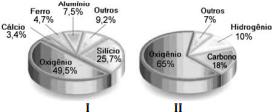
Adaptado de: http://www.quimlab.com.br/guiadoselementos/
Os sistemas I e II correspondem, respectivamente,
Questão
21 10318947
Fácil
OBG 2015
Constituem respectivamente os minerais mais duro e mais mole da Terra:
Questão
2 10302701
Fácil
OBR 1° Ano - Nível 5 2015
Read the text below:
“Exploring volcanoes is risky business. That’s why Carolyn Parcheta and her co-advisor, JPL robotics researcher Aaron Parness, are developing robots that can get into crevices where humans wouldn’t be able to go, gaining new insights about these wondrous geological features. (...) The research has implications for extraterrestrial volcanoes. On both Earth and Mars, fissures are the most common physical features from which magma erupts. This is probably also true for the previously active volcanoes on the moon, Mercury, Enceladus and Europa, although the mechanism of volcanic eruption -- whether past or present -- on these other planetary bodies is unknown, Parcheta said.
(...) Parcheta, Parness, and JPL co-advisor Karl Mitchell first explored this idea last year using a
two-wheeled robot they call VolcanoBot 1, with a length of 12 inches (30 centimeters) and 6.7-
inch (17-centimeter) wheels. (...) For their experiments in May 2014, they had VolcanoBot 1 roll
down a fissure – a crack that erupts magma – that is now inactive on the active Kilauea volcano in
Hawaii. Finding preserved and accessible fissures is rare. VolcanoBot 1 was tasked with mapping
the pathways of magma from May 5 to 9, 2014. It was able to descend to depths of 82 feet (25
meters) in two locations on the fissure, although it could have gone deeper with a longer tether, as
the bottom was not reached on either descent.”
(Fonte: www.nasa.gov – Credits: Elisabeth Landau, JPL-Caltech)
Based on the text above, it is right to say:
Questão
27 10170573
Fácil
IFPR Médio Integrado 2015
O Sol e o Sistema Solar surgiram a partir de:
Questão
23 10170359
Fácil
IFPR Médio Integrado 2015
O movimento da Terra cuja principal consequência é a sucessão dos dias e das noites é:
Questão
22 10170338
Fácil
IFPR Médio Integrado 2015
Considerando o tempo geológico da Terra, “resfriamento da Terra e a formação das primeiras rochas” ocorreu predominantemente em: